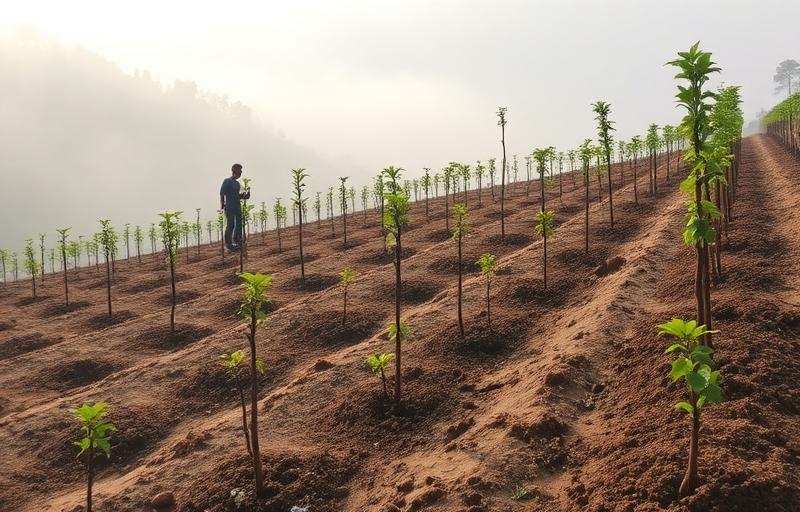
Corporate Tree Planting: The CSR & ESG Compliance Guide for 2026
Corporate tree planting has evolved from a feel-good photo opportunity into one of the most cost-effective levers for Corporate Social Responsibility (CSR) and Environmental, Social, and Governance (ESG) compliance. For sustainability leaders under pressure to report verified climate action, reforestation now offers something rare: measurable carbon impact, community co-benefits, and a story stakeholders actually understand.
This guide explains what high-quality corporate tree planting looks like in 2026, how it maps to specific ESG frameworks, and how to evaluate the ROI of a reforestation partnership.
Why corporate tree planting matters for ESG
Modern ESG disclosure regimes — BRSR in India, CSRD in the EU, and SEC climate rules in the US — increasingly require companies to quantify and verify climate action, not just describe it. Corporate tree planting, when done well, produces audit-grade evidence across all three ESG pillars:
- Environmental: Verified CO₂ sequestration (a mature native tree absorbs ~22 kg of CO₂ per year), restored biodiversity, soil and water regeneration.
- Social: Rural livelihoods, women's self-help group income, school and community engagement, and improved local air quality.
- Governance: Geotagged plantation records, third-party survival audits, and transparent impact reporting that boards and auditors can rely on.
Crucially, reforestation is one of the few CSR interventions where the unit economics are simple enough to defend on a quarterly call: cost per tree, survival rate, tonnes of CO₂ sequestered, and beneficiaries reached.
How corporate tree planting maps to ESG frameworks
A well-structured reforestation program contributes to multiple disclosure standards at once:
- GHG Protocol Scope 3 (Category 15) and SBTi neutralization: Native-species plantations with long-term monitoring contribute to residual-emissions neutralization once you have credible MRV (Measurement, Reporting, Verification).
- UN Sustainable Development Goals: Directly advances SDG 13 (Climate Action), SDG 15 (Life on Land), SDG 5 (Gender Equality) via women-led nurseries, and SDG 8 (Decent Work).
- India BRSR Principle 6 and CSR Schedule VII (item iv): Eligible for the 2% mandated CSR spend, with documented environmental sustainability outcomes.
- CSRD / ESRS E4 (Biodiversity) and E1 (Climate Change): Provides quantitative biodiversity and carbon disclosures with site-level granularity.
Section 135 of the Companies Act: how tree plantation qualifies as CSR in India
Under Section 135 of the Companies Act, 2013, every company with a net worth of ₹500 crore or more, turnover of ₹1,000 crore or more, or net profit of ₹5 crore or more in a financial year must spend at least 2% of its average net profit of the preceding three financial years on CSR activities. Tree plantation and reforestation are explicitly eligible under Schedule VII, item (iv) — "ensuring environmental sustainability, ecological balance, conservation of natural resources and maintaining quality of soil, air and water".
To make a plantation programme audit-ready under Section 135:
- Partner with a CSR-1 registered implementing agency. Since April 2021, CSR funds may only be routed through entities registered with the MCA (Form CSR-1) — ask for the registration number before transferring funds.
- Board and CSR committee approval. The plantation project must appear in the board-approved annual CSR action plan, with defined outlay, timelines, and implementation modalities.
- Impact assessment. Companies with CSR obligations of ₹10 crore or more must commission an independent impact assessment for projects of ₹1 crore or more — geotagged sapling data makes this straightforward.
- Annual report disclosure. Project-wise spend, location, and outcomes must be disclosed in the Board's Report and, for listed companies, in BRSR Principle 6.
- Unspent funds discipline. Unspent amounts on ongoing projects must be moved to an Unspent CSR Account within 30 days of year-end — multi-year plantation and maintenance contracts help schedule spend predictably.
Because plantation drives carry three-year maintenance obligations, they qualify neatly as "ongoing projects" under the CSR Rules, letting companies commit multi-year budgets rather than scrambling for year-end spend.
Employee engagement: the underrated CSR multiplier
Plantation drives are one of the few CSR activities employees can physically participate in. A well-run corporate drive typically pairs a half-day on-site plantation with a named, geotagged sapling per employee, a digital certificate, and a live impact dashboard the team can revisit. That combination drives measurably higher participation than donation-only programmes, supplies authentic internal-communications content, and strengthens the "S" in ESG with volunteering hours you can actually report.
The ROI of corporate tree planting
The return on a reforestation partnership shows up across five line items:
- Carbon abatement cost: Verified native plantations typically deliver CO₂ sequestration at $10–$30 per tonne over 20 years — competitive with most engineered offsets and far cheaper than direct air capture.
- Brand equity and earned media: Geotagged, story-driven plantation drives generate authentic content for LinkedIn, ESG reports, and customer marketing.
- Employee engagement: Volunteer plantation drives consistently rank among the highest-NPS CSR activities, improving retention in sustainability-conscious talent pools.
- B2B procurement advantage: Increasingly, enterprise RFPs and supplier scorecards now require Scope 3 commitments — documented reforestation strengthens vendor positioning.
- Regulatory headroom: A defensible reforestation portfolio reduces the cost of complying with future climate disclosure rules before they tighten.
What "good" looks like: a 7-point checklist
Not every tree planted is equal. Before signing a corporate tree planting partnership, insist on:
- Native species only — no fast-growing monocultures that fail in year three.
- Geotagged saplings with GPS coordinates published on a public impact map.
- Survival rate ≥ 85% at 24 months, verified by a third party or drone audit.
- Community ownership — local self-help groups or farmer collectives maintain the plantation for at least three years.
- Transparent unit economics — published cost per tree, with a breakdown of sapling, planting, maintenance, and MRV costs.
- Annual ESG-grade impact report with photographs, dashboards, and downloadable CSR certificates for your auditors.
- Co-benefit measurement — beneficiaries supported, women trained, water conserved, hectares restored.
How EarthXway delivers corporate tree planting for CSR and ESG
EarthXway partners with companies across India and globally to deliver corporate tree planting programs designed from day one for ESG compliance. Every drive is community-led, every sapling is geotagged, and every partner receives:
- A dedicated CSR dashboard with live tree counts, survival rates, and CO₂ sequestered.
- Section 80G / CSR-eligible donation receipts and certificates within 48 hours.
- BRSR-ready impact reports with photographs, beneficiary stories, and audit-grade metrics.
- Optional employee volunteer drives, co-branded plantation sites, and ESG case studies.
Whether you are allocating your mandated 2% CSR spend, building a Scope 3 neutralization portfolio, or launching a new sustainability narrative for stakeholders, corporate tree planting with a trusted partner is one of the fastest ways to convert intent into reportable impact.
Get started
If you are evaluating a corporate tree planting program for your 2026 ESG roadmap, EarthXway's partnerships team can scope a pilot drive, share sample impact reports, and walk you through framework mapping for your specific disclosures.
About Earthxway Foundation
About Earthxway Foundation: a Nagpur-based tree plantation NGO working across India. Learn more at earthxway.org.